Affiliate Disclosure: Pet Symptom Story participates in the Amazon Services LLC Associates Program. If you buy through a link on this page, I may earn a small commission at no extra cost to you. I only write about products I have used in my own home, and a commission never changes what I tell you about a pet's health.
Most of the messages I get about house-soiling start the same way: "He was perfect for eight years, and now there's a puddle by the door every morning." Before we talk about products, I want to say the thing I say in clinic — a sudden change in urination habits is medical information first. Increased volume, increased frequency, straining, or accidents in a previously reliable adult pet deserve a urinalysis, not a scolding. Please book that appointment.
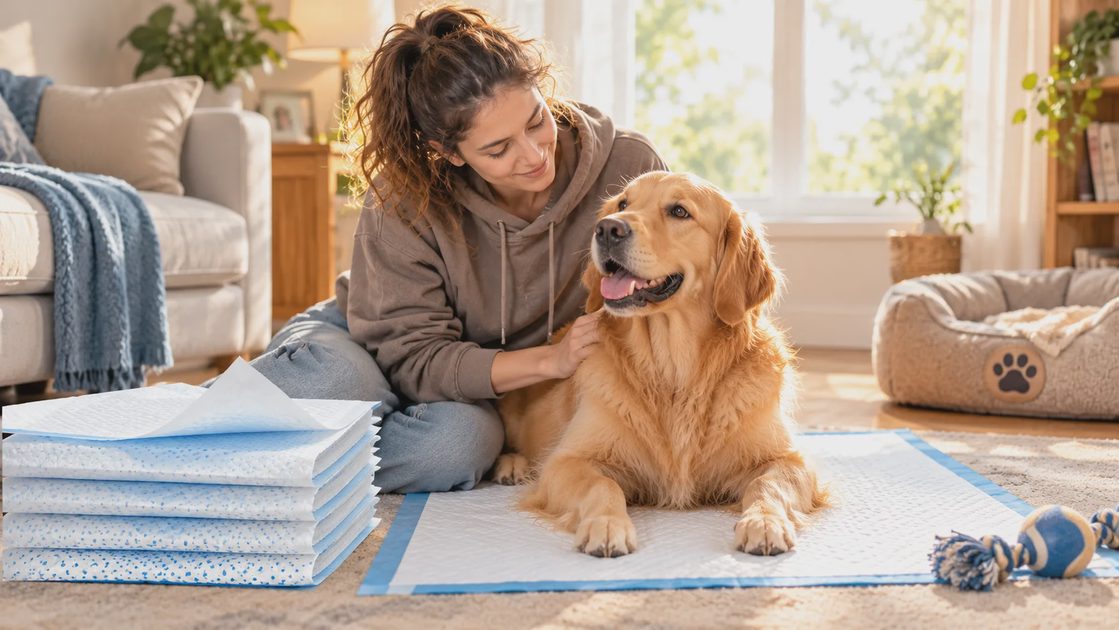
But here's the part nobody warns you about: even after you have a diagnosis and a plan, life at home still has to function. A senior dog on a diuretic still produces a lot of urine at 3 a.m. A post-op patient on crate rest still has to go. That gap — the weeks or months between "we know what's wrong" and "this is manageable" — is where I started buying extra large dog pee pads, and specifically the XXXXL 31"x55" pads I've been using with my own 62-pound retriever mix since early summer.
Why Pads Fail, and Why It's Usually Not the Dog's Fault
The volume math most owners never run
A standard "large" pad is around 23"x36" and is built to hold a few hundred milliliters. A healthy dog produces roughly 20–40 ml of urine per kilogram of body weight per day, and dogs with kidney disease, diabetes, Cushing's, or a prescribed diuretic can blow well past that. One overnight void from a big dog can be 300–500 ml on its own.
So when an owner tells me "the pad didn't work," what usually happened is one of three things:
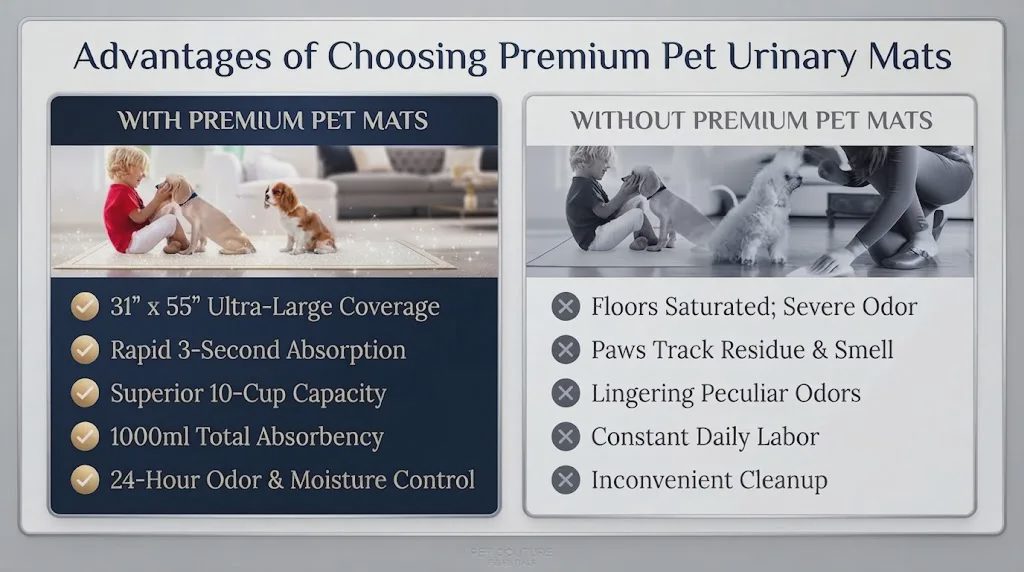
The pad reached capacity and the excess pooled on top
The dog's paws hit the saturated center and tracked urine across the room
The dog stepped past the edge entirely, because big dogs circle before they squat
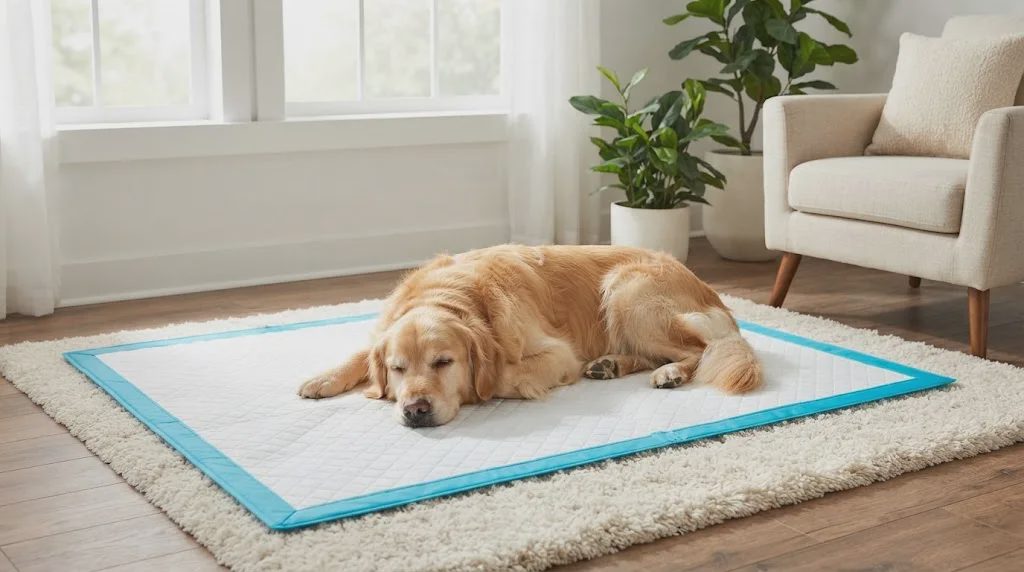
The last one is the quiet killer. A dog doesn't aim. A dog rotates, shuffles, and then goes. If your pad is the size of a placemat relative to your dog, the geometry is working against you from the start.
Where the actual mess starts
In clinic we see the downstream version of this all the time: urine scald on the belly and inner thighs of pets who've been resting in damp bedding, and owners who feel terrible because they genuinely didn't know. Keeping a large, absorbent surface under a leaky pet isn't a convenience purchase. For a senior with reduced mobility, it's skin care.
What Two Months With the 31"x55" Pads Actually Looked Like
I want to be honest about my own bar here, because I am not an easy customer. I've bought pads that felt like paper towels taped to a grocery bag.
Night one, and the three-second thing
The listing claims absorption in about 3 seconds. I didn't time it with a stopwatch, but I did the unglamorous test: I poured a full measuring cup of water onto the center of a pad on my kitchen tile and watched. It went from puddle to nothing-visible almost immediately, and by the time I pressed a paper towel onto the spot, the towel came up damp rather than wet. That gel-lock behavior is the whole ballgame. Liquid that stays liquid is liquid that ends up on your baseboards.
The size difference was more emotional than I expected. Seeing a 55-inch-long pad unfolded next to my dog's bed, I realized how long I'd been asking a small pad to do a big dog's job.
The overnight test
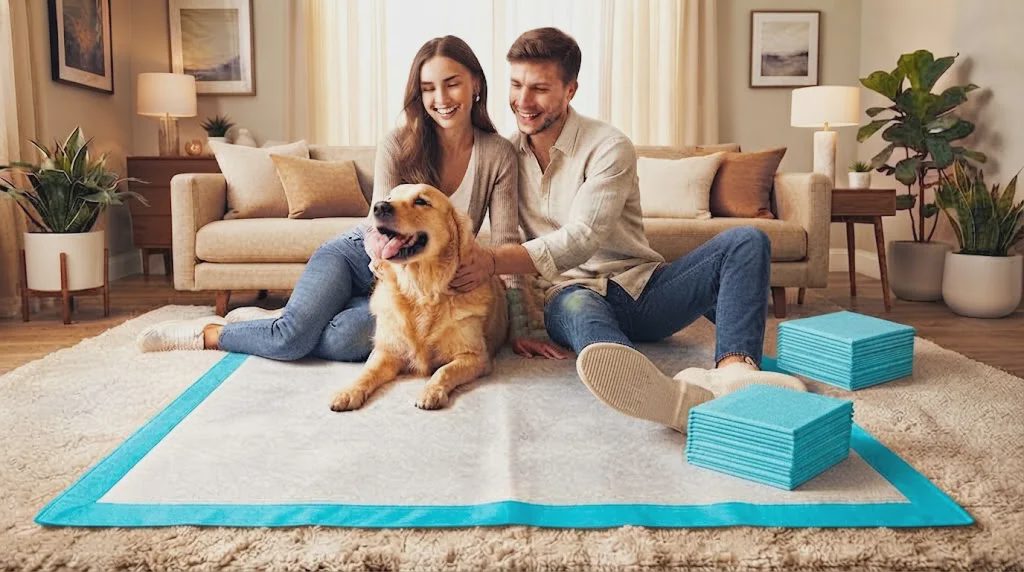
The product describes a capacity around 10 cups (1000 ml) and claims it stays dry for 24 hours. My real-world use has been more modest and, I think, more useful to you: one pad reliably handled a full night for my dog, including two separate voids, without anything reaching the edges. I swapped it every morning regardless — not because it was failing, but because odor control is about removal, not absorption.
What I noticed most was the absence of a specific sound. You know the one. The little tick tick tick of damp paws on hardwood. It stopped.
I also stopped waking up at 2 a.m. to check. That sounds like a small thing, and it isn't. Owners caring for a chronically ill pet are running on interrupted sleep for weeks at a stretch, and sleep debt makes everything else — the medication schedule, the appetite tracking, the patience — measurably harder. Anything that buys you a full night without a cleanup is doing more for your pet's care than it looks like on paper.
What my floors told me
Three things I tracked without meaning to:
No tracking. The surface stays dry to the touch even when the core is loaded, which is the practical difference between a good pad and a cheap one.
The border held. The PE film wraps the back and the edges, so the seam is where liquid stops, not where it wicks out.
Pickup was clean. A saturated pad lifts as one piece. Thin pads tear at the corner and redistribute everything you were trying to contain.
A Plain-English Look at the Construction
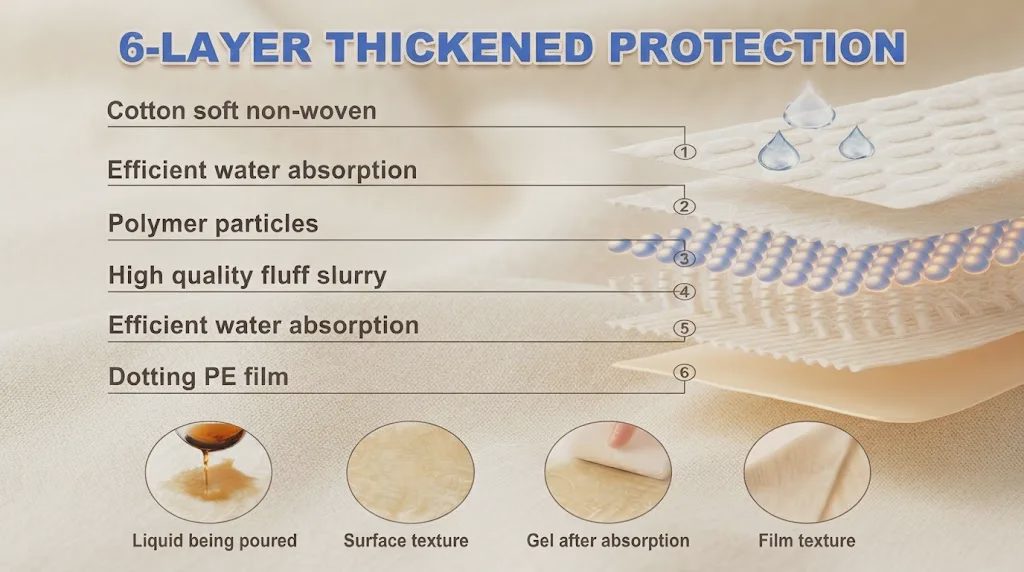
The packaging talks about a 6-layer build and 12 grams of super absorbent polymer. Translated:
The layers that matter
The top sheet and absorption layers move liquid off the surface fast, away from paws and skin
Polymer particles are the actual workhorse — they convert liquid into gel so it can't migrate back out under pressure
Fluff pulp distributes liquid outward instead of letting it sit in one saturated crater
A dotted PE film backing blocks anything from reaching your floor
The pads are polypropylene, blue, and the company describes them as roughly 50% thicker than standard pads. Thickness sounds like a marketing word until you've knelt on a thin pad to help an arthritic dog stand up and felt the floor through it.
Where these pads fall short
Two things you should know going in. First, they're bulky — 40 XXXXL pads is a genuinely large box, around 8.9 pounds, and it needs real storage space. Second, at this size you're using more material per accident than you would with a smaller pad, so if your dog is a small breed or a reliably centered piddler, you'd be overpaying for surface area you never touch. Neither of these is a dealbreaker for a big or senior dog. Both are worth knowing before you order a case.
Making This a Routine Instead of an Emergency
The per-pad math I run
The 40-count box of the 31"x55" size runs $38.99, which works out to about $0.97 per pad. I'll admit that number made me pause at first — a dollar a night felt like a lot until I compared it to what I was actually spending before, which was two cheap pads per night plus enzyme cleaner plus the slow, unrecoverable cost of a hardwood floor absorbing urine at the seams.
Because this is an ongoing need for us, I switched to the Subscribe & Save option at $37.04 ($0.93 per pad), which drops a box on my porch without me having to remember. For a chronic condition, that autopilot matters more than the savings do. It ships from Amazon and is sold through the shuangrenxing-us storefront, and it carries the Amazon's Choice badge in the disposable training pads category with a 4.4-star average across 417 ratings — not a flawless score, but a believable one.
When a pad is a tool, not an answer
I'll close where I started, because this is a pet health site and I'd rather be useful than persuasive. A pee pad manages a symptom. It does not treat polyuria, it does not treat a urinary tract infection, and it does not treat the incontinence that sometimes follows spay surgery in older females — which, for what it's worth, is often very responsive to medication.
Use the pad to protect your floors, protect your pet's skin, and protect your own sleep while you work the medical problem with your veterinarian. That's the right job for it. Buying a better pad and calling the problem solved is the one mistake I'd genuinely ask you not to make.
Frequently Asked Questions




No notes yet — write the first one.